
Your needs, this model
Does it fit your priorities?
Does the Explorer 2 reach a 140 cm setting?
Yes. The product page states a 100–140 cm usable range. Check your own fit and the exact configuration; 140 cm is the documented upper endpoint.
Explore this need in the finder →Does it fit a 65 cm collapsed-length limit?
No. Its published collapsed length is 81 cm, so it exceeds 65 cm. A different length-adjustable pole can still be too long for the planned pack space.
Explore this need in the finder →Is its grip definitely EVA foam?
The manufacturer page is internally inconsistent: its feature text says EVA foam, but the Materials list identifies the grip as 100% TPR. This assessment leaves the grip classification unknown, so it does not satisfy a hard EVA request without clarification.
Explore this need in the finder →Are snow baskets confirmed in the box?
No snow-basket inclusion is stated. The page says baskets are replaceable and notes that extra baskets do not come with the poles; those statements do not identify the supplied basket type.
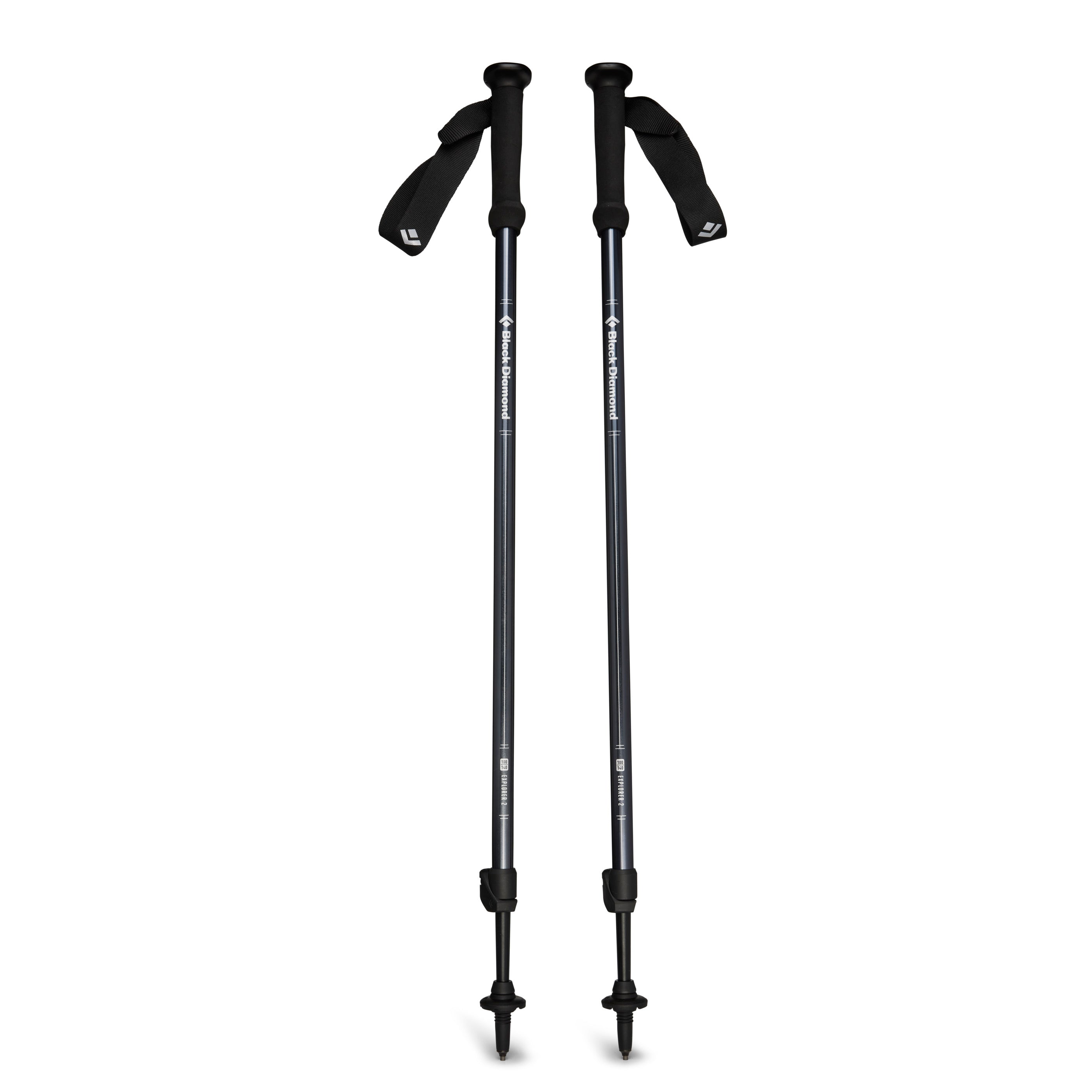
Explore this need in the finder →The Explorer 2 is an adjustable aluminum trekking pole with a 100–140 cm usable range and a two-section shaft. The detail that most changes its fit is the 81 cm collapsed length: it reaches the same listed maximum as the three-section Explorer 3, but stores substantially longer.
Identity and length plan
The US product feed currently lists a single Ink Blue color SKU, BD1125504014ALL1, with no separate size selector. Black Diamond's product page describes a two-section pole and gives a 100–140 cm usable range, an 81 cm collapsed length and a 460 g listed weight. The weight basis is not stated on that page, so do not treat it as a per-pole or per-pair figure or compare it directly with a weight that explicitly names its basis. The 100–140 cm range is adjustable in use, which helps a shopper who wants to reset pole height on changing terrain. It is not a fixed-length design. Set the poles using the exact instructions and check that the specific offer is the Explorer 2 rather than its visually related three-section sibling. A maximum setting is not a personal sizing recommendation; check grip height and wrist position on level ground and on the slopes you hike.Two sections and an 81 cm pack length
The two-section arrangement has fewer shaft joins than the Explorer 3, but that alone does not establish greater strength or durability. Its published collapsed dimension is the more actionable distinction: 81 cm will not satisfy a 65 cm storage ceiling. The three-section Explorer 3 lists 61.5 cm collapsed, while the telescoping Trail is listed at 64.6 cm. Compare the exact measured dimension with a pack sleeve or attachment point; neither the product name nor a picture tells you what fits your bag.The grip description conflicts within the source
There is a real documentary conflict on the manufacturer's own page. The feature text calls the grip EVA foam, but the Materials list identifies the grip as 100% TPR. Because the sources do not resolve that discrepancy, this assessment and finder leave its main-grip material unknown. It should not pass a hard EVA-foam requirement on the basis of the feature sentence alone. Ask the seller or manufacturer for clarification if that choice would determine your purchase, and check the exact model code rather than assuming the nearby Explorer 3 has the same materials.Replaceable baskets are not a snow-basket package claim
The page says the baskets are replaceable and specifically notes that extra baskets do not come with the poles. It does not identify snow baskets as included with the selected configuration. This is an evidence limit, not proof that a compatible snow basket cannot be purchased separately. If supplied snow baskets are essential, the Explorer 3 has a clearer manufacturer statement that it comes with them; the Trail Back is another separate assessment with its own basket evidence. Do not move package facts between these models. Black Diamond positions the Explorer 2 for day hikes, shorter treks and snowshoeing, and calls the FlickLock mechanism quick to adjust. Those are manufacturer descriptions, not a report of our testing. For maintenance and lock tension, use the maker's trekking-pole instructions and inspect the lock before relying on it.Practical verdict
This configuration is a plausible candidate when you want a 100–140 cm telescoping range and can accommodate 81 cm while packed. Its two biggest qualification checks are the internally inconsistent grip material and unconfirmed snow-basket inclusion. Confirm those facts if they matter; do not let the similar Explorer names blur the Explorer 2's two-section build, longer collapsed dimension or unresolved package details. The product page also lists PFAS-related shipping restrictions for several states, so verify delivery eligibility at checkout.Key specifications
Key details at a glance
| Minimum usable length | 100 cm |
|---|---|
| Maximum usable length | 140 cm |
| Collapsed length | 81 cm |
| Manufacturer-listed weight (basis shown in product notes) | 460 g |
| Adjustable working length | Yes |
| Shaft material | Aluminum |
| Adjustment lock | External lever clamp |
| Shaft sections | 2 |
| Shaft storage design | Telescoping |
Use the exact model’s instructions for operating limits, supplied equipment and version differences.
Sources for this review
Sources for this assessment
Build a shortlist around your pole-length and trail needs.
The finder compares only documented settings and supplied features. Unknown details are not treated as a match.