
Your needs, this model
Does it fit your priorities?
What working-length range does the LT5 manufacturer guide for hiking?
The manufacturer's trekking guidance uses the marked 105–130 cm range. The sections can be shortened further for some shelter-pitch arrangements, but that lower setup range is not treated as a trekking working range in this assessment.
Explore this need in the finder →Will the LT5 fit a 55 cm pole compartment?
The manufacturer lists a fully collapsed length of 60 cm, so a 55 cm ceiling is too short on the published dimension. Check the compartment opening and any compression allowance rather than assuming the length will compress further.
Explore this need in the finder →Are snow baskets included with the LT5?
The reviewed product details list baskets and rubber boots but do not identify the built-in baskets as snow baskets. Treat snow-basket inclusion as unconfirmed and check the exact seller's package before relying on it.
Explore this need in the finder →The LT5 is a three-section carbon trekking-pole pair aimed at hikers who put a low listed weight ahead of a short folded length. This is an evidence-based assessment of Gossamer Gear’s current product page and product record, not a hands-on test. The maker gives a 105–130 cm marked hiking range, a 60 cm fully collapsed dimension and a weight of 139 g per pole. Those are useful specifications, but each answers a different question: reach, pack fit and individual-pole mass.
Three telescoping sections, not a short folding bundle
The LT5 uses telescoping carbon sections and twist locks. That layout lets a user adjust length within the maker’s ordinary hiking range, but the assembled bundle remains longer than a short-folding pole. At 60 cm fully collapsed, it is a better fit for a pack that accepts longer pole sections than for a small carry-on sleeve or a compact daypack pocket. Measure the usable compartment opening rather than assuming that a stated length will fit diagonally or through a narrow zipper.
Gossamer Gear’s instruction notes make a distinction worth keeping: the pole can be adjusted below the marked hiking range for a tarp or shelter setup, while the marked 105–130 cm band is the guidance for walking. This assessment uses the latter as the working-length plan. A very low shelter-pitch height does not show that the pole should be walked with at that setting. The manufacturer also marks 125 cm for some shelter pitches; compatibility is tied to those specific designs, not every trekking-pole tent.
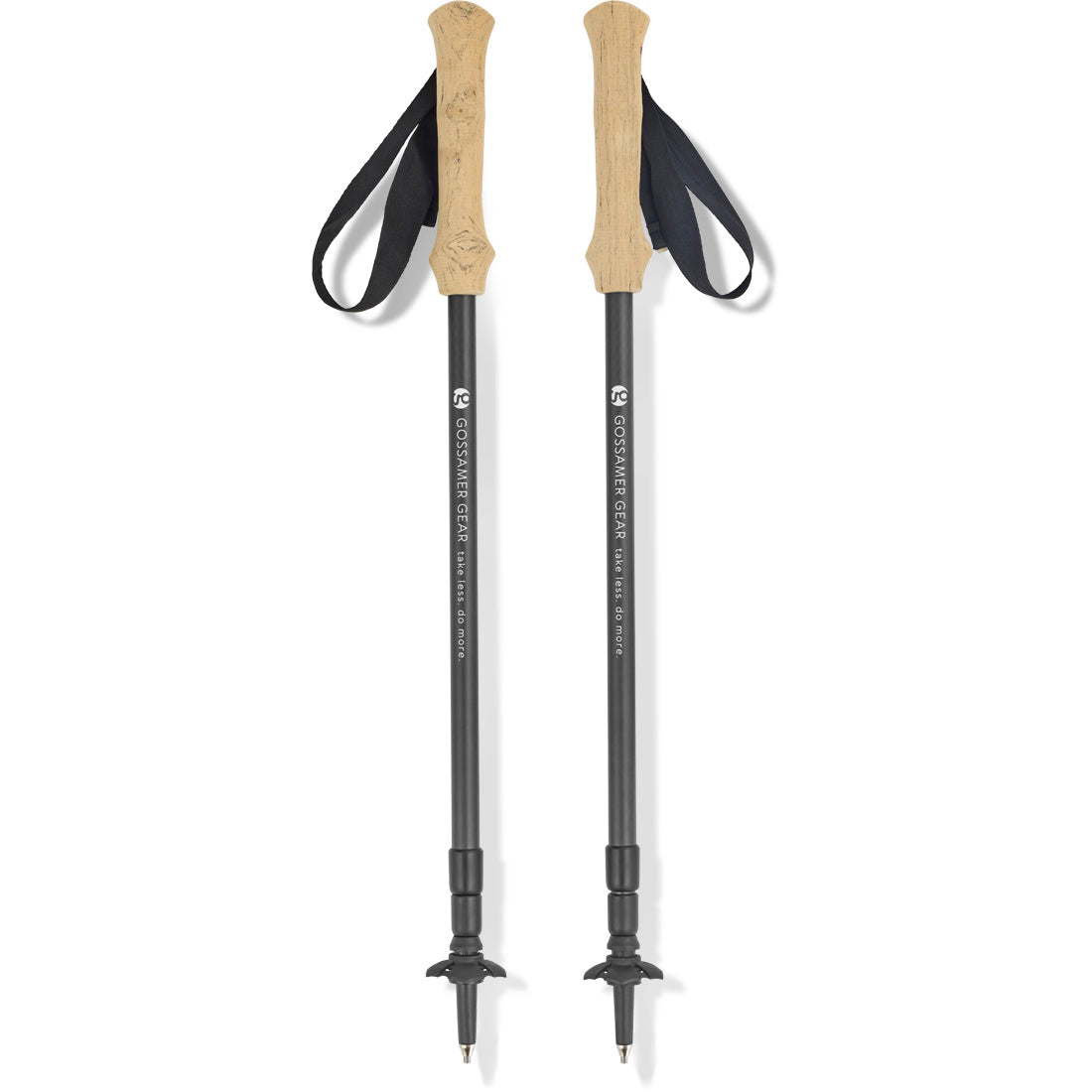
The product is explicitly presented as a pair. The published 139 g figure is per pole, however, so it should not be compared with another brand’s unlabeled or per-pair number. The official page lists EVA foam at the grip, carbon-fiber shafts, carbide tips and rubber boots; it gives a separate mass for the boots. A product photo may show color or finish, but the written source is the basis for those material and inclusion details.
Where its light construction asks for care
Low swing weight can matter over repeated steps, especially for hikers who already know that they prefer carbon poles. It does not establish impact resistance or a safe load. Gossamer Gear specifically cautions against using the shafts to catch a fall or levering them sideways against rocks. The maker also says carbon breakage is not covered by its warranty. That warning is a meaningful tradeoff for rocky routes, off-trail probing or a user who expects a pole to act as a brace under awkward lateral force. It is not proof that this model will fail in a particular situation; it is a limit on how to interpret a light carbon design.
The listed built-in basket and supplied rubber boots are not the same thing as a confirmed snow-basket package. The product page names baskets but does not identify their type as snow baskets. A hiker who needs winter flotation should check the exact item and seller package rather than infer snow use from the fact that some basket is present. Likewise, replacement sections are separate items, not evidence that a seller includes spare shafts with a new pair.
LT5 and FT3 serve different packing routines
Gossamer Gear’s FT3 folds to a shorter 38 cm, while the LT5 collapses to 60 cm. The FT3 also has a shorter minimum walking setting and a cord-connected folding layout; the LT5’s documented advantage is its telescoping/twist-lock adjustment and lower per-pole listed mass. If you routinely stow poles inside a small pack, the FT3’s geometry is the clearer starting point. If the pack accepts a 60 cm section and you want the LT5’s marked 105–130 cm trekking range, this model addresses that different constraint. Neither claim makes one the universal winner.
Before choosing the LT5, check that the 105–130 cm range covers the settings you intend to use, that 60 cm fits your actual pack, and that the exact offer is for the LT5 pair rather than one replacement section. Confirm the rubber boots and other package contents if they matter. If your intended use includes snow travel, ask the seller to identify the baskets by type. Finally, read the maker’s instructions for setting the twist locks and loading carbon shafts; no performance test or personal use is claimed here.
Key specifications
Key details at a glance
| Manufacturer-listed weight (basis shown in product notes) | 139 g |
|---|---|
| Published weight entries (mapping or basis may be unclear) | 139 g |
| Published collapsed-length entries (size mapping may be unclear) | 60 cm |
| Adjustable working length | Yes |
| Shaft material | Carbon fiber |
| Adjustment lock | Twist lock |
| Grip material | EVA foam |
| Shaft sections | 3 |
| Published collapsed-length entries (size mapping unclear) | 60 cm |
| Published weight entries (mapping or basis may be unclear) | 139 g |
| Shaft storage design | Telescoping |
Use the exact model’s instructions for operating limits, supplied equipment and version differences.
Sources for this review
Sources for this assessment
Build a shortlist around your pole-length and trail needs.
The finder compares only documented settings and supplied features. Unknown details are not treated as a match.